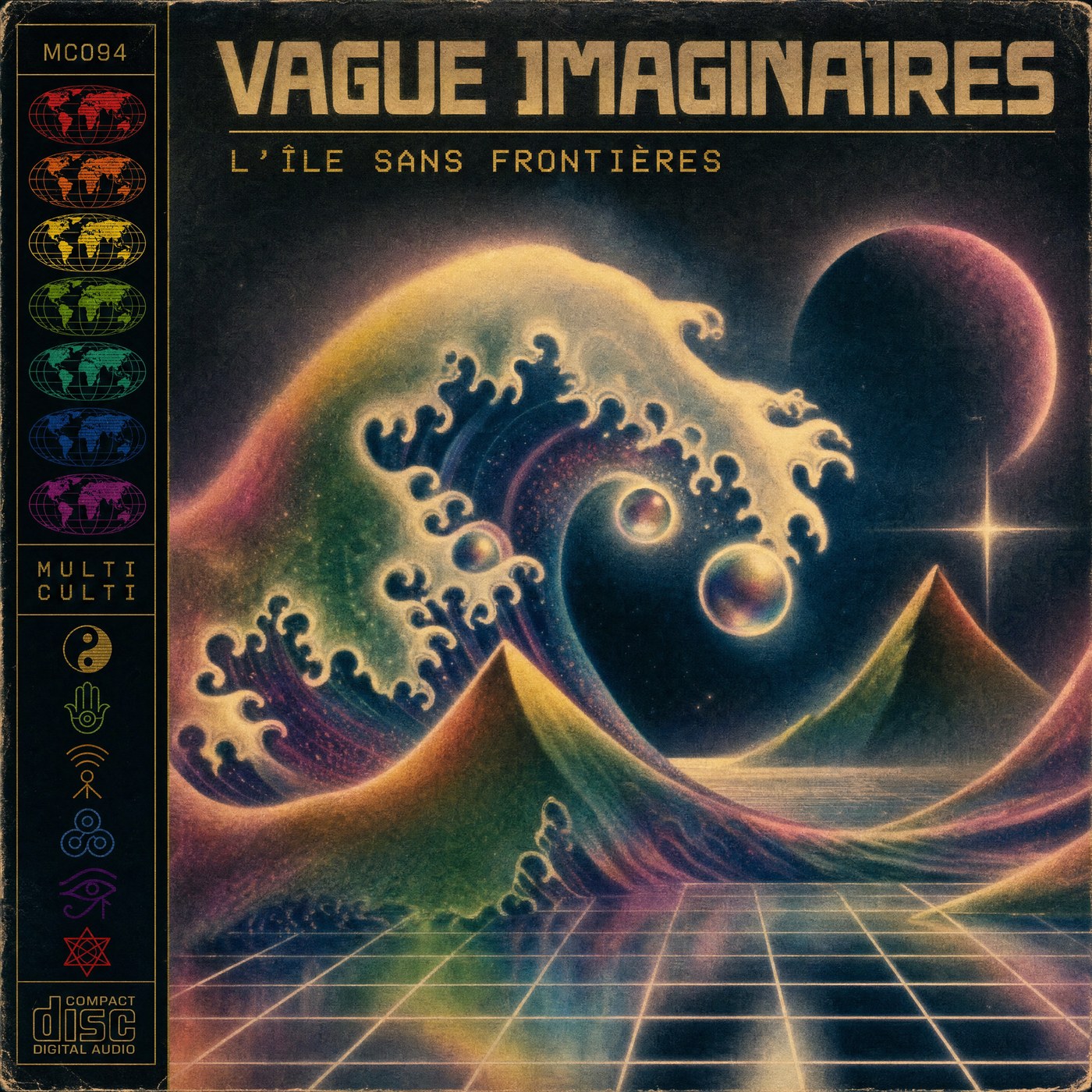
VAGUE
IMAGINAIRES
L'ÎLE SANS FRONTIÈRES


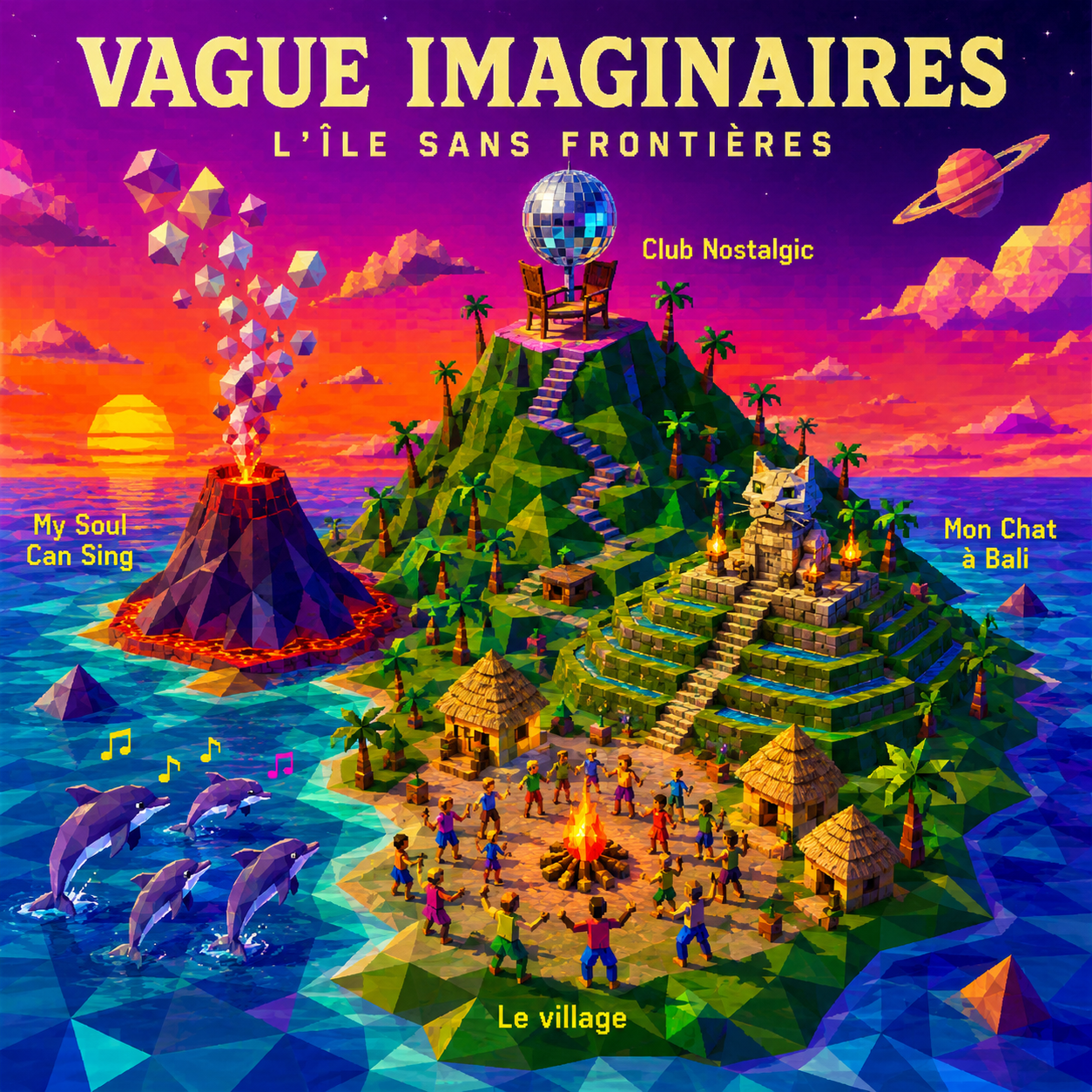
You have arrived on a small island. It has no fixed shape — it forms and reforms each time someone listens. Five tracks, recorded across workshops, shared apartments, mountain houses and sleepless nights, gathered here as a kind of autobiography in sound.
Each room below holds a story, the music itself, and moving pictures. Wander freely. The borders are yours to draw.


Born out of a workshop held with migrants at a vocational training center. The idea came in first: that we all carry a village in memory — near or far — a small community organized around a territory rather than a family. Improvising on a Roland Juno-DI with a digital marimba sound and some echo, a simple rhythm was built together while Delphino collected phrases around the theme. The Village grew from vocal improvisations and fragmentary stories, and very quickly the idea spread of a universal village. Afghan, West African and European voices answered each other without trying to represent a fixed identity, but rather a shared memory held in common.
The track rests on a minimal, almost childlike structure: a few percussions, drops of marimba in the sun, slow pulses. From that fragile material — words, vocal percussion, scraps of autotuned singing — came improvisation, reaching blindly into the Roland's enormous sound bank in an Afghan style or a creole zouk feel.
The “village” here is not a closed or folkloric territory. It's an inner sensation: an absent place that nonetheless keeps living inside bodies, languages and memories — the small village of the internet, the singular opposite of the impersonal big city. A way of relativizing the class differences felt among the participants; the freedom of the temporary, nomadic camping village against the rigidity of the closed-off sedentary world. Less about telling a story than making a provisional common space appear. The idea of an “island without borders” gradually takes shape here — not a pure utopia, but a shifting sonic territory where collective memory circulates freely between people, cultures and eras.
♫ LISTEN
▶ MOVING PICTURES


Dolphin Dance grew out of a childhood fascination with commercial dance music and certain Japanese electronic productions of the '90s and 2000s — particularly the rhythmic delicacy and the highs (especially the hats) of Shinichi Atobe. The track chases that discreet euphoria you sometimes find in Japanese minimal house: something floating, naive and precise.
It started from a very simple synthetic motif — luminous and euphoric, the kind of thing danced to like crazy at ten years old alone in a bedroom. Around it, layers accumulated gradually like ocean currents, always with the same sound across all its forms and degrees of lo-fi, with a few notes of icy jazz piano as breath. The hi-hat became the track's central obsession — not a simple rhythmic element but a source of energy, made to shine and scratch at the edge of the bearable.
Threaded through with very personal memories: the sensation of windsurfing, bodies in motion, the silent speed on water. The title deliberately plays with an assumed naivety — the dolphin as an almost absurd or tender figure, a symbol of simple freedom detached from adult cynicism. Beneath its lightness, something more fragile: as if the party, the water and the memory were collapsing into a single floating material.
♫ LISTEN
▶ MOVING PICTURES



Mon Chat à Bali also came out of the shared-apartment period — right after Deep in Blue. A time of making music around the clock, experimenting as much as possible with resonators; life revolving around clubbing and long absurd conversations. Built in that energy of daily celebration, as an ode to imagination — its groove obsessed for weeks, in tons of versions.
It started with a synthetic hook, a rhythm immediately sent through the blue of the resonator and tape effects, around which dub echoes and digital bells accumulated — arriving like a merry-go-round coming loose before free fall. With a Kenzo ad line in mind — “somewhere at the other end of the world” — and aquatic textures and the sounds of waves and retreating foam, the thought turned to Bali: a kind of organic steam engine to carry the mind there through the trance of the body. The most “Drexciyan” thing here, deep into Afrofuturism at the time.
The title works as a deliberately off-kilter image. It's by steam rocket, by space train, that the cat gets to Bali — a small interior fiction, an imaginary escape in the middle of a daily life saturated with music and sleepless nights. A lot of dub techno influence with a deep and progressive side: hi-hats releasing their juice, floating cymbals fraying at the edges, toms getting lost like thunder in the jungle; resonances singing like birds — a story of freedom guided by the randomness of tweaking the knobs.
♫ LISTEN
▶ MOVING PICTURES


My Soul Can Sing was built around a text by Etheridge Knight, discovered through The Future Sound of London on their Psychedelic Bubble album — which samples a reading by Robert Bly, James Hillman and Michael Meade from a CD called Men and the Life of Desire. The violence of the text, its destructive humor and its solitary energy — a righteous rage chanted loud, concealing a desperate tenderness — served as the starting point. A full-on rant that mocks every form of puritanism, that at the end of the day is mostly a broken heart letting the demon out.
Built quickly in 2017 using an FSOL cut, then reworked twice — it had a following but was too short and left fans wanting more. Eventually the original sample was tracked down, layered over the FSOL version, and worked out into a longer form. The track maps onto a period of life in a shared apartment where it was a party every day; the living room regularly served as a dancefloor, the place known among Grenoble party people.
The first VST Predator sound tried was the right one, and the 707/727 asserted itself through its dryness, its sharp attacks and its demonic whistle. The disordered percussion and insistent hook give the track a dumb, reckless energy — something on the verge of exploding, just like the text. And it's funny that it's only coming out now, right in the middle of a breakup.
♫ LISTEN
▶ MOVING PICTURES


The most recent track, representing the period being lived right now. Called “Club Nostalgique” because with this life there isn't much going out anymore — priorities shifted with the arrival of two daughters and the idea of leaving behind a physical legacy, not just an artistic one. A whole period of feeling genuinely left behind, a sense that the new generation had taken the wheel — without jealousy or reaction, still loving the new generations, but no longer able to honestly claim it was new. And carrying a nostalgia for those first club moments, for the time when electronic music organized the schedule, the encounters, the desires.
Started up at Clavans, in a mountain house: open Ableton, lay down a drum machine that signals retro (the C78), then chords with an equally retro pad, a small ambient techno hook and some solid subs. A tearful, almost strident organ, because nostalgia stings a little; then club elements repurposed — the high-pitched strings used to build tension in Chicago house, that very club-typical early house bass that makes the track breathe.
But it needed a real story. That's when a DX7 synthetic voice sound arrived and the melodies started improvising — genuinely airy, suspended in the air, recounting a happy memory held aloft, but also something like a new wind moving forward. This track is like a page turned by the wind — but nostalgia here is a source of energy, something complete.
♫ LISTEN
▶ MOVING PICTURES
The album is called L'île sans frontières — “The Island Without Borders” — and there's something slightly paradoxical in an island being without borders, because borders inevitably take shape with the sea all around. What has no borders is also the time that separates the different moments of a life. This music has always been worked as a kind of autobiography: it marks a singular instant, and at the same time tries to be a moment of eternity — an instant never truly lost, one that can be returned to infinitely in depth, by remixing, by reinterpreting it at the threshold of new skills or new musical desires.
And sometimes, mercifully, certain tracks are selected by a label and their hour comes to be fixed — the hour of forming a new island that is never really well-defined, because the grip is released on these tracks and it becomes the audience's turn to interpret them, to give them their own shifting, final borders.